Hercules Screw Pile Installation Machine
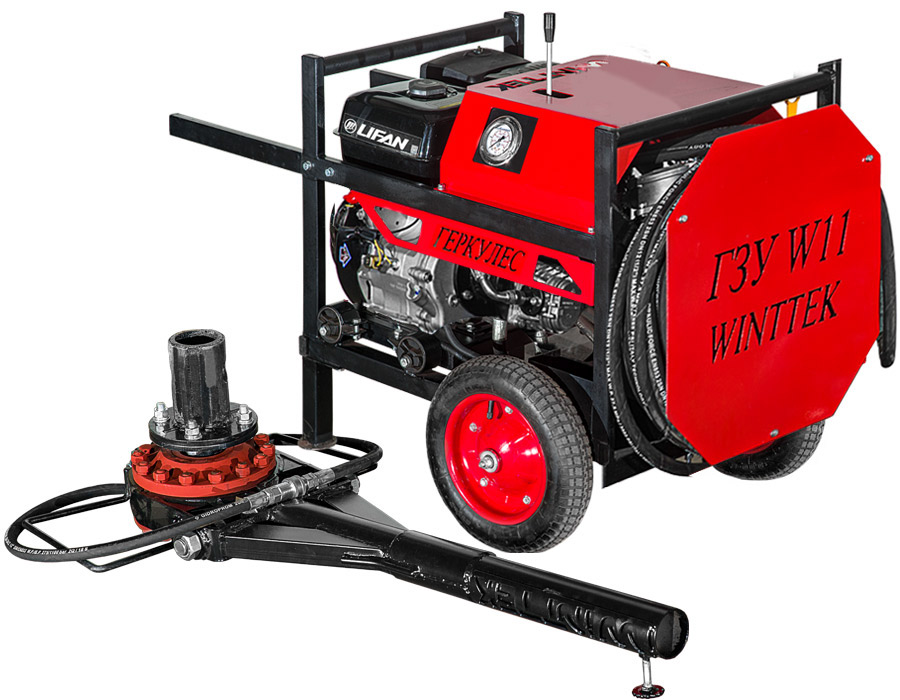 You are most likely reading this article because you visited the Equipment section (if you have not, we recommend doing so) and became interested in our "Hercules Screw Pile Installation Machine" (click the text highlighted in red to see the machine’s technical specifications). Having covered the specifications, we will not repeat them here. Instead, we will explain how the machine came into being, discuss some of its benefits proven through our own experience, and share other interesting details.
When we started manufacturing screw piles, installation was already intended to be part of the company’s business. Like everyone else, we began with simple tools and brute physical strength. In some cases, we hired earth augers, pile installation machines and similar equipment mounted on various chassis to install screw piles. We still have assorted adapter wrenches in the warehouse for every eventuality. Rental costs consumed a significant share of the profit. Almost immediately, we also discovered that we were losing quite a few customers. You have probably guessed which ones and why. Exactly: extensions, buildings on slopes, holiday home and garden plots that are small, built up and planted, and so on. On top of that, during the busy season, the crew could not keep up with all the orders. Hiring additional temporary staff would, among other things, mean compromising pile installation quality, which was completely unacceptable. This gave rise to the idea of a mechanical helper. After looking at what the market offered, we quickly realised that none of it suited us. We also already knew that, if successful, the machine would become one of our products. Its development was far from easy, although we tried to draw on the experience of those who came before us. We have to admit that the design and first prototype were quite successful: Hercules proved to be at the limits of what this kind of equipment can achieve, as operation later confirmed, in terms of the balance between power, weight, dimensions, mobility and, of course, price. Beyond that lies specialised machinery with a correspondingly "special" price tag. From the outset, Hercules was positioned as an income-generating tool for small screw pile installation businesses, including those starting from scratch, and as a way for larger installation companies to make full use of their capabilities. If this interests you, read more about setting up such a business in Business Idea: A Small Screw Pile Installation Company.
It was redesigned and rearranged several times, and components were changed… But we achieved our goal: a screw pile installation machine named Hercules was created. We are rather proud to say that we all have a little of the USSR in us. What does that have to do with the machine? We drew on its mechanical engineering experience and developments too. 1. Structural strength, perhaps excessive in places. 2. Simplicity of design. 3. Ease of operation, intended for any reasonably capable installer. 4. Ease of maintenance and repair: replacement parts can be found, when needed, in every regional capital and most district centres. Work on Hercules continues today, drawing on the operating experience of WINTTEK and its customers.
We felt the benefits immediately. There was no need to keep expanding the workforce; we began accepting the most difficult and complex jobs, stayed busy in winter, and almost eliminated expensive rentals of third-party machinery, among other things. We have heard countless words of thanks from the installers and builders who bought it, as well as from end customers whose seemingly impossible problems, arising during construction or even at the design stage, were solved with Hercules. There are many examples; here are just a few.
A customer ordered a turnkey foundation for a timber bathhouse. Delivery of the building kit had already been scheduled, but he could not decide whether to follow the design or change it to accommodate where, how and what type of stove he would install, along with a fireplace and a water tank.
Penalties for keeping the builders and machinery idle were looming. He had already approved the pile foundation design, and we knew nothing of his doubts. Eventually, he told us. We gently teased him about his worries and suggested that he spare the builders the stress and have the timber shell erected on the main pile foundation on the agreed date. We would provide the foundation for the stove and other items once he had made up his mind (the floors were to be installed last, using some old Russian method). But everything was close to the walls, and the rooms were relatively small! What worried him most was that the supply and installation package included the ceiling and roof. When he learned that this was no obstacle for us either, and that neither the builders nor we would charge him more for it, he was delighted. Still, he demanded proof. Of course, we demonstrated Hercules. He had never seen the dozens of online videos of similar equipment… And even if he had, given his creative profession, he would probably not have realised that Hercules could handle his situation too. The result: the timber shell was erected, the roof was in place (autumn and its rains were approaching!), and we completed our work as promised. In other words, the customer was happy.
The customer did have to pay extra after all, which somewhat dampened his delight. The reason was that no geotechnical investigation had been carried out, nor had any trial pile installation. Knowing that the site could be problematic from our building experience in the area, we had recommended these from the outset. But, as so often happens, the desire to save money won out. During installation, he was shown that the pile kept going deeper without reaching a load-bearing layer, making extensions unavoidable. He was still fortunate: extending the piles by just one metre proved sufficient, and management also accommodated him by charging the minimum for the additional services. We think the interested neighbours, who have construction plans of their own and watched all the twists and turns of the installation, will learn from this practical lesson.
A construction company bought screw piles from us for the foundation of a timber house on a garden plot. Can you see the catch? As the saying goes, too many cooks spoil the broth… Despite experience with piles and their installation as a regular customer of ours, the company had overlooked one thing: all the project information was scattered among the minds and paperwork of numerous people, rather than brought together. On arriving at the plot, the builders discovered a bathhouse already standing to the left, apple trees planted by the grandfather (!!!) spreading out to the right, and the grandmother’s much-loved, carefully tended flower bed behind (another sacred spot!!!). The customer must have thought screw pile installers were magicians who could hover over flower beds like yogis… When the director arrived at the scene, he immediately realised that a UBM-type drilling rig could only be brought onto the site by helicopter, which was well beyond the construction budget. Fortunately, he still knew where to find us and was familiar with our pile installation machine and its capabilities. He had been considering one for some time.
The result: we arrived on site and solved the "problem" (hardly a problem!), leaving all the treasured features untouched. However, all the installation profit went to WINTTEK rather than the construction company. That got the director thinking, and he bought a Hercules ahead of the next building season. The company also ended up with fewer careless "cooks".
A company received an order to build a timber frame house to replace a dilapidated old one. The plot was small, the soil problematic, and roughly once every 10 years it flooded (up to 1 metre in a "good" flood!). But there was no choice: buying another plot was expensive, and available land was becoming scarcer… There seemed to be no alternative to a screw pile foundation. It was selected, and the piles were purchased. As the company had never installed screw piles before, it brought in subcontractors. They were not us; aggressive underpricing was probably the reason. They were getting ready to install the piles when nature once again showed that it pays no attention to hypothetical plans, let alone human wishes. Unseasonal, prolonged rain began, and the UBM rig could not reach the plot without tearing up everything around it. Unpleasant, but manageable: the piles could still be installed manually. Then, at the last moment, the customer decided that since the house had to stand high anyway, he would raise it almost 2 metres above ground to make better use of the open space on the small plot, using the area beneath the house as a carport, summer veranda and so on. He also categorically rejected welded joints anywhere on the piles (after reading about them online…). Now imagine manually installing screw piles spaced 2 metres apart and projecting the same 2 metres above the ground. Manually, remember… Naturally, the subcontractor sensibly declined the job, partly because the deadline (we forgot to mention that familiar little detail of Russian construction) was, naturally, fast approaching… The company you already know took on the work and, as usual, completed it. The result: the customer was happy, and construction continued. To be honest, we were somewhat lucky: the bearing soil layer was at a depth of 1,7-1,9 m (we managed to persuade the customer that trial installation was necessary). The total pile length was therefore 4 m, well within the capabilities of our Hercules.
There was another outcome. The builders began to wonder why they should depend on subcontractors and lose a substantial profit on pile foundation installation. A UBM-type rig would never pay for itself in their business, even if they also hired it out. Our Hercules, with its price and capabilities, was exactly what they needed.
After reading and seeing all this, you may be tempted to build something similar yourself. But consider whether that is really the right solution for you. Do you have at least a year to spend on trial and error? And another couple of years to correct and refine everything? Would it not be easier and more profitable to use a finished product and start earning money now, without spending extra time and funds? Our customers chose to buy Hercules and have already confirmed for themselves that they made the right choice.
Finally, we should say that none of the stories or characters refers to any particular person or company. Any resemblance is coincidental.
At the same time, we have invented nothing. Everything above is a composite portrait of the installers, builders, buyers and customers we have encountered throughout our company’s history. It is far from complete, so there will be more stories.
But those are for other articles.